Return To Book 3 Table Of Contents
A Critical Lesson In History...
As I neared the completion of my second book, Breaking The Code To Remove The Shackles of Autism: When The Parts Are Not Understood And The Whole Is Lost! and, as I read more and more on matters of autism, I became very concerned that materials I read so often included references to another disorder – references to a disorder that seemed so completely unrelated to autism. Within me, there was soon that “inner voice” telling me to look deeper into this issue – and so I did.
I found that this “other disorder” simply had “too many parallels to autism” for my comfort. This second disorder was – Alzheimer’s! I knew autism had previously been called “childhood schizophrenia”, but finding so many parallels between autism and Alzheimer’s raised a huge red flag within me. As such, I decided to spend some time investigating Alzheimer’s – and then, with those findings, I then decided to also investigate schizophrenia.
Provided below was a chart of parallels I had found among these disorders. Note especially the “previously called” comment on this chart in terms of the name by which each disorder was previously known.
Although this research project was not entirely completed, with over one hundred and forty parallels among these three disorders, I had seen enough to know there was reason to be concerned and certainly enough information to have a “discussion” of these issues – and hence – the reason for my writing this book.
The latest version of this chart was available on my website: http://www.autismhelpforyou.com. This information was provided to Congressman Dan Burton as official testimony entered on behalf of the public for the December 10, 2002 hearings on vaccinations.
Autism - Alzheimer's - Schizophrenia Comparison
Was all this "just coincidence"?
|
YOU DECIDE... |
||
|
AUTISM |
ALZHEIMER'S |
SCHIZOPHRENIA |
|
Age 1 - 6 |
Age 40 on (youngest case, age 28), greater frequency with increase in age |
Early teens - 40 |
| Epidemic levels (estimates range from 1 in 250, to 1 in 150 impacted). | Epidemic levels (over 85 years old, 50% impacted, 75-85 20% impacted, 65-75 10% impacted, now seeing people in their 40s and 50s with Alzheimer's. Youngest documented case = 28 years old). | Epidemic levels (1 in 100 impacted) |
|
Previously called: Childhood Schizophrenia Discovered by Leo Kanner |
Previously called: Dementia Praecox Discovered by Alois Alzheimer's - worked for Emil Kraepelin and was considered Emil Kraepelin's protégé |
Previously called: Dementia Praecox Discovered by Emil Kraepelin Kraepelin - the man also most closely associated with Bi-polar |
| Gradual onset usually, but can be sudden | Gradual onset | Gradual onset usually, but can be sudden |
| Short term, long term and working memory impacted | Short term, long term and working memory impacted | Short term, long term and working memory impacted |
| Lethargic, no energy | Lethargic, no energy | Lethargic, no energy, decreased motivation |
| Loss of intellectual abilities (ie., problems with abstract thinking) | Loss of intellectual abilities (ie., problems with abstract thinking) | Loss of intellectual abilities (ie., problems with abstract thinking) |
| Impact on social activities and everyday tasks | Impact on social activities and everyday tasks | Impact on social activities and everyday tasks |
| Suffer from "sensory overload" (ie., can only handle so much sensory input at once) | Suffer from "sensory overload" (ie., can only handle so much sensory input at once) | Suffer from "sensory overload" (ie., can only handle so much sensory input at once) |
| Process, sequencing and task completion issues | Process, sequencing and task completion issues | Process, sequencing and task completion issues |
| Hand over hand techniques help (ie., do the first step in the task and they can continue on) | Hand over hand techniques help (ie., do the first step in the task and they can continue on) | STILL NEED TO INVESTIGATE |
| Judgment issues (ie. Wearing wrong clothes for the season) | Judgment issues (ie. Wearing wrong clothes for the season) | Judgment issues (ie. Wearing wrong clothes for the season) |
| Some have difficulty determining where their body stops and something else begins | STILL NEED TO INVESTIGATE | Some have difficulty determining where their body stops and something else begins |
| Inability to follow simple instructions | Inability to follow simple instructions | STILL NEED TO INVESTIGATE |
| Problems with face and voice recognition | Problems with face and voice recognition | Problems with face and voice recognition (see/hear things or see distortions) |
| Unable to recognize self in a mirror | Unable to recognize self in a mirror | May not recognize self/see distorted self in a mirror |
| Unable to perceive what others are thinking | STILL NEED TO INVESTIGATE | Unable to perceive what others are thinking |
| Difficulty with language production | Difficulty with language production | Difficulty with language production |
| Difficulty with language comprehension | Difficulty with language comprehension | Difficulty with language comprehension |
| Unable to process rapid speech | Unable to process rapid speech | Issues with rapid speech |
| Difficulty with conversation | Difficulty with conversation | Difficulty with conversation |
| Pronoun confusion/self-reference issues | Pronoun confusion/self-reference issues | Pronoun confusion/self-reference issues |
| Nonsense language | Nonsense language | Nonsense language |
| Echolalia (parrot what others say) | Echolalia (parrot what others say) | Echolalia (parrot what others say) |
| STILL NEED TO INVESTIGATE | STILL NEED TO INVESTIGATE | Thought insertion issues (say that thoughts they have belong to someone else). I suspect “thought insertion” may result from seizures known as “psychic seizures”. In these seizures, persons report experiencing “forced thoughts”, in addition to issues with concept of self, concept of reality, etc. |
| Repetition of words (their own) | Repetition of words (their own) | Repetition of words (their own) |
| Use "related words" in speaking (reference communication based on word associations) | Use "related words" in speaking (reference communication based on word associations) | Use "related words" in speaking (reference communication based on word or sound associations) |
| Flat, monotone or high pitch speech | STILL NEED TO INVESTIGATE | Flat, monotone speech |
| Do not understand humor, sarcasm or "expressions" | Do not understand humor, sarcasm or "expressions" | Do not understand "expressions" |
| Can read but not understand meaning of what is read | Can read but not understand meaning of what is read | STILL NEED TO INVESTIGATE |
| May be mute | May be mute | May be mute |
| "Deaf child" syndrome - appear to be deaf but hearing tests normal | "Deaf adult" syndrome - appear to be deaf but hearing tests normal | "Deaf adult" syndrome - appear to be deaf (also problems with auditory hallucinations, yet, appear able to accurately "hear" instructions to perform specific tasks) |
| Little or no response to stimuli or need more time "to respond" | Little or no response to stimuli or need more time "to respond" | Little or no response to stimuli or need more time "to respond" |
| Issues with concept of self (self is "lost") | Issues with concept of self (self is "lost") | Issues with concept of self (self is "lost") |
| Wander off, easily disoriented | Wander off, easily disoriented | STILL NEED TO INVESTIGATE |
| Often don't know how to "turn around"/issues with direction changes | Often don't know how to "turn around"/issues with direction changes | STILL NEED TO INVESTIGATE |
| Follow "repetitive path" during daytime | Follow "repetitive path" during daytime | STILL NEED TO INVESTIGATE |
| Balance issues | Balance issues | STILL NEED TO INVESTIGATE |
| Abnormal gait | Abnormal gait | Abnormal gait |
| Issues with safety/don't perceive danger (ie., walk in middle of street) | Issues with safety/don't perceive danger (ie., walk in middle of street) | Issues with safety/don't perceive danger (ie., walk in middle of street) |
| Decreased attention span, inability to concentrate | Decreased attention span, inability to concentrate | Decreased attention span, inability to concentrate |
| Attention transition issues | Attention transition issues | Attention transition issues |
| Focus on "parts" as opposed to "the whole" | STILL NEED TO INVESTIGATE | Focus on "parts" as opposed to "the whole" |
| Blank stares | Blank stares | Blank stares |
| Poor eye contact | Poor eye contact | Poor eye contact |
| Regression in behavior | Regression in behavior | Regression in behavior |
| Lack of physical coordination | Lack of physical coordination | Lack of physical coordination |
| Poor eye-hand coordination | Poor eye-hand coordination | STILL NEED TO INVESTIGATE |
| Hand/arm flapping | Hand/arm flapping | Hand/arm flapping |
| Odd and inappropriate behaviors | Odd and inappropriate behaviors | Odd and inappropriate behaviors |
| Repetitive ritualistic behaviors/task fixation (ie., walking around in circles, purposeless movement) | Repetitive ritualistic behaviors/task fixation (ie., walking around in circles, purposeless movement) | Repetitive ritualistic behaviors/task fixation (ie., walking around in circles, purposeless movement) |
| Picking at things and wandering aimlessly indoors (possible sign of seizures) | Picking at things and wandering aimlessly indoors (possible sign of seizures) | Aimless motor activity |
| Self-injurious behaviors (ie., head banging, biting, etc.) | Self-injurious behaviors (ie., head banging, biting, etc.) | Self-injurious behaviors (ie., head banging, biting, suicide attempts, etc.) |
| Pain insensitivity | Difficult to determine if this is an issue. Caregivers often have a very difficult time determining if Alzheimer's patient is in pain or not. | Pain insensitivity |
| Turn lights or switches on and off | Turn lights or switches on and off | STILL NEED TO INVESTIGATE |
| Tearing of things (papers, one's clothing, etc.) | Tearing of things | Tearing of things (papers, one's clothing, etc.) |
| Can be in catatonic-like state | Can be in catatonic-like state | Can be in catatonic-like state |
| Constantly "sorting" things | Constantly "sorting" things | STILL NEED TO INVESTIGATE |
| Want objects placed in a specific manner only | Want objects placed in a specific manner only | STILL NEED TO INVESTIGATE |
| "Hoarding" behaviors | "Hoarding" behaviors | "Hoarding" behaviors |
| Issues with getting dressed (ie., need help with basics) | Issues with getting dressed (ie., need help with basics) | Issues with getting dressed (ie., need help with basics) |
| Undress in public | Undress in public | Undress in public |
| Myoclonal movement (sudden, brief, jerking motions) | Myoclonal movement (sudden, brief, jerking motions) | Myoclonal movement (sudden, brief, jerking motions) |
| Find comfort in "rocking" motion | Find comfort in "rocking" motion | Find comfort in "rocking" motion |
| Difficulty understanding facial expressions | Difficulty understanding facial expressions | STILL NEED TO INVESTIGATE |
| Problems expressing emotions, emotional unresponsiveness | Problems expressing emotions, emotional unresponsiveness | Problems expressing emotions, emotional unresponsiveness |
|
Issues with time perception |
Issues with time perception | Issues with time perception |
| Little or no body language | Little or no body language | Little or no body language |
| Grimacing | Grimacing | Grimacing |
| Unprovoked and/or inappropriate crying/laughter | Unprovoked and/or inappropriate crying/laughter | Unprovoked and/or inappropriate crying/laughter |
| Issues with sense of touch | STILL NEED TO INVESTIGATE | Issues with sense of touch |
| Upset by changes in environment | Upset by changes in environment | Upset by changes in environment |
| Routines appear to help/insist or engage in "unusual" routines also | Routines appear to help/insist or engage in "unusual" routines also | Routines appear to help/insist or engage in "unusual" routines also |
| Music therapy found helpful | Music therapy found helpful | Music therapy found helpful |
| Subject to hallucinations (Delusions in this age group would be difficult to assess) | Subject to hallucinations and delusions (see Updates section on my website for my thoughts on why delusions may be seizures involving parts of brain dealing with reality and concept of self ) | Subject to hallucinations and delusions (see Updates section on my website for my thoughts on why delusions may be seizures involving parts of brain dealing with reality and concept of self ) |
| Sensitivity to gluten/grain proteins (acts as natural opiate/hallucinogen) | Sensitivity to gluten/grain proteins associated with dementia | Sensitivity to gluten/grain proteins |
| Sensitivity to casein/milk protein (acts as natural opiate/hallucinogen) | High levels of casein kinase-1 (CK-1) found in nerve cells inside cellular sacs called vacuoles and as such CK-1 is now considered a possible "marker" for Alzheimer's. CK-1 also appears to play a role in tau protein functions and dopamine. | Sensitivity to casein/milk protein |
| Low levels of DHA (fatty acid found in milk that impacts neuro and retinal development) | Low levels of DHA (fatty acid found in milk that impacts neuro and retinal development) | Low levels of DHA (fatty acid found in milk that impacts neuro and retinal development) |
| Changes in eating patterns (ie., some want to eat all the time, others must almost be forced to eat) | Changes in eating patterns (ie., some want to eat all the time, others must almost be forced to eat) | STILL NEED TO INVESTIGATE |
| Difficulty in swallowing | Difficulty in swallowing | STILL NEED TO INVESTIGATE |
| Weight loss | Weight loss | Weight loss |
| Issues with differentiating "reality" verses the "non-real" (i.e., unable to pretend at first, but when "learn to pretend", pretending can become excessive, talking to imaginary friends, etc.) | Issues with differentiating "reality" verses the "non-real" (i.e., pretending, talking to imaginary friends, etc.) | Issues with differentiating "reality" verses the "non-real" (i.e., pretending, talking to imaginary friends, etc.) |
| Irrational fears | Irrational fears, paranoid | Irrational fears, paranoid |
| Inappropriate sexual behavior | Inappropriate sexual behavior | Inappropriate sexual behavior |
| Bathing issues are common | Bathing issues are common | Bathing issues are common |
| Abnormal sleep patterns | Abnormal sleep patterns | Abnormal sleep patterns |
| Symptoms vary among those affected | Symptoms vary among those affected | Symptoms vary among those affected |
| Pacing | Pacing | Pacing |
| Twirl hair | Twirl hair | Twirl hair |
| Make up own words or sounds | Make up own words or sounds | Make up own words or sounds |
| Disorganized, fragmented thoughts | Disorganized, fragmented thoughts | Disorganized, fragmented thoughts |
| Difficult to assess in this age group | STILL NEED TO INVESTIGATE | Preoccupation with religion or the occult |
| STILL NEED TO INVESTIGATE | STILL NEED TO INVESTIGATE | Unusual body positioning |
| Aggression | Aggression | Aggression |
| Agitation/hyperactivity/constant movement | Agitation/hyperactivity/constant movement | Agitation/hyperactivity/constant movement |
| Anxiety | Anxiety | Anxiety |
| Apathy | Apathy | Apathy |
| Can physically abuse caregivers | Can physically abuse caregivers | Can physically abuse caregivers |
| Confusion | Confusion | Confusion |
| Depression | Depression | Depression |
| Irritability | Irritability | Irritability |
| Loss of spontaneity | Loss of spontaneity | Loss of spontaneity |
| Mood variability | Mood variability | Mood variability |
| Neglect basic hygiene (many not potty trained until very, very late, issues with brushing teeth, hair, etc.) | Neglect basic hygiene | Neglect basic hygiene |
| Rage | Rage | Rage |
| Socially withdrawn, prefer to stay alone | Socially withdrawn, prefer to stay alone | Socially withdrawn, prefer to stay alone |
| Stubbornness | Stubbornness | Stubbornness |
| Tantrums/screaming | Tantrums/screaming | Tantrums/screaming |
| Abnormal brain mass/structure (some sections larger than normal, others smaller ) | Abnormal brain mass/structure (tremendous degeneration/loss of cells, enlarged ventricles) | Abnormal brain mass/structure (smaller brain overall, enlarged ventricles, huge loss of gray matter) |
| Abnormal neural cell division/maturation/migration | Abnormal neural cell division/maturation/migration | Abnormal neural cell division/maturation/migration |
| Abnormal calcium metabolism | Abnormal calcium metabolism | Abnormal calcium metabolism |
| Abnormal copper-zinc metabolism | Abnormal copper-zinc metabolism | Abnormal copper-zinc metabolism |
| Abnormal neurotransmitter levels of dopamine | Abnormal neurotransmitter levels of dopamine | Abnormal neurotransmitter levels of dopamine |
| Abnormal GABA receptor functions | Abnormal GABA receptor functions | Abnormal GABA receptor functions |
| Abnormal neurotransmitter levels of norepinephrine | Abnormal neurotransmitter levels of norepinephrine | Abnormal neurotransmitter levels of norepinephrine |
| Abnormal neurotransmitter levels of serotonin | Abnormal neurotransmitter levels of serotonin | Abnormal neurotransmitter levels of serotonin |
| Abnormal sulfate levels | Abnormal sulfate levels | STILL NEED TO INVESTIGATE |
| Basal ganglia implications found (note: girls have larger basal ganglia than boys - may offer more protection) | Basal ganglia implications found (incl. high iron in basal ganglia) | Basal ganglia implications found |
| Brain lesions found | Brain lesions found | STILL NEED TO INVESTIGATE |
| Changes found in brain asymmetry | Changes found in brain asymmetry | Changes found in brain asymmetry |
| Brain stem defects in some cases - in reticular formation | Brain stem defects in some cases - in reticular formation | STILL NEED TO INVESTIGATE |
| Carnosine supplementation helpful | Carnosine supplementation helpful | STILL NEED TO INVESTIGATE |
| Cortical acetylcholine deficiency | Cortical acetylcholine deficiency | STILL NEED TO INVESTIGATE |
| Dysfunction in brain cell myelination processes | Dysfunction in brain cell myelination processes | Dysfunction in brain cell myelination processes |
| Digestive system problems (irritable bowel syndrome, yeast, GI flora imbalance, diarrhea, etc.) | Digestive system problems (yeast, colitis, etc.) | Digestive system problems (irritable bowel syndrome) |
| Abnormal glutamate and aspartate levels | Abnormal glutamate and aspartate levels | Abnormal glutamate and aspartate levels |
| Elevated homocysteine levels | Elevated homocysteine levels | Elevated homocysteine levels |
| Essential fatty acid (EFA) deficiencies | Essential fatty acid (EFA) deficiencies | Essential fatty acid (EFA) deficiencies |
| Fusiform gyrus abnormality found | Fusiform gyrus abnormality found | Fusiform gyrus abnormality found |
| Gender issues (4X more boys impacted). Note: Male brain is known to mature slower than female brain. | Gender issue more difficult to establish since women live longer. | Gender issues (male age of onset - 2 peak periods, 7-9 and 15 -25, female onset, 25-35). Note: Male brain is known to mature slower than female brain! |
| Glial cells implicated in disorder (glial cells act as "scaffolding" allowing neurons to grow and connect with other neurons) | Glial cells implicated in disorder | Glial cells implicated in disorder (Hans Moises et al. hypothesized that glial cells are weakened by viruses and that this may lead to schizophrenia) |
| Cerebellum abnormalities noted (very immature part of brain in young children, immature cells appear more "targeted" by mercury) | Cerebellum more spared - by this age, cerebellum had the time to mature - it takes up to 20 years for this part of the brain to reach maturity. Amyloid plaques found. | Cerebellum abnormalities noted |
| Impact on Purkinje and granular cells | Impact on Purkinje and granular cells | Impact on Purkinje and granular cells |
| Impact on T-cells/immune system | Impact on T-cells/immune system | Impact on T-cells/immune system |
| Impaired motion perception | Impaired motion perception | Impaired motion perception |
| Impaired spatial perception | Impaired spatial perception | Impaired spatial perception |
| Impaired visual/peripheral perception | Impaired visual/peripheral perception | Impaired visual/peripheral perception |
| Inability to control bladder/bowels | Inability to control bladder/bowels | STILL NEED TO INVESTIGATE |
| Iron overload consistently found | Iron overload consistently found (can lead to amyloid deposits) | STILL NEED TO INVESTIGATE |
| Issues with boron | Issues with boron | STILL NEED TO INVESTIGATE |
| Issues with insulin levels | Issues with insulin levels | Insulin therapy used since 1940s |
| STILL NEED TO INVESTIGATE | STILL NEED TO INVESTIGATE | Issues with glucose levels |
| STILL NEED TO INVESTIGATE | Carbohydrate deposits found in brain | Carbohydrate deposits found in brain |
| Limb apraxia | Limb apraxia | STILL NEED TO INVESTIGATE |
| Low glutathione levels | Low glutathione levels | Low glutathione levels |
| LOW lactoferrin levels | HIGH lactoferrin levels in spinal fluid | STILL NEED TO INVESTIGATE |
| Low magnesium levels | Low magnesium levels | Low magnesium levels |
| Low taurine levels are common | Low taurine levels are common | STILL NEED TO INVESTIGATE |
| Melatonin issues | Melatonin issues | Melatonin issues |
| Metallothionein (MT) protein dysfunction | Metallothionein (MT) protein dysfunction | STILL NEED TO INVESTIGATE |
| Mitochondrial dysfunction in brain | Mitochondrial dysfunction in brain | Mitochondrial dysfunction in brain |
| Nitric oxide production issues | Nitric oxide production issues | Nitric oxide production issues |
| Often develop epilepsy at puberty | Drugs used for epilepsy useful in treatment of disorder, seizures | Seizures are common |
| Over-responsive immune system | Over-responsive immune system | Over-responsive immune system |
| Possible APO-E genotype issue | Possible APO-E genotype issue | Possible APO-E genotype issue |
| Possible issues with "sniffing" and olfactory dysfunction | Possible issues with "sniffing" and olfactory dysfunction | Olfactory dysfunction |
| Problems with amygdala functioning | Problems with amygdala functioning | Problems with amygdala functioning |
| Problems with hippocampus functioning | Problems with hippocampus functioning (hippocampus devastated yet known to produce new cells into age 50, perhaps age 70 thus mercury may again be targeting immature cells) | Problems with hippocampus functioning |
| Problems with anterior cingulate | Problems with anterior cingulate | Problems with anterior cingulate |
| STILL NEED TO INVESTIGATE | STILL NEED TO INVESTIGATE | Thalamus issues found |
| Enlarged ventricles found in some | Enlarged ventricles in brain | Enlarged ventricles in brain |
| Reduced muscarinic receptor binding | Reduced muscarinic receptor binding | STILL NEED TO INVESTIGATE |
| Sight and sound sensitivity | Sight and sound sensitivity | Sight and sound sensitivity |
| Sensitivity to textures | STILL NEED TO INVESTIGATE | Sensitivity to textures |
| Unusual sweating | Unusual sweating | STILL NEED TO INVESTIGATE |
| Poor circulation | Poor circulation | Poor circulation |
| Vitamin deficiency - especially in B group | Vitamin deficiency - especially in B group | STILL NEED TO INVESTIGATE |
| Vitamin E supplementation helpful | Vitamin E supplementation helpful | Vitamin E supplementation helpful |
|
Often fail to produce proper antibodies when vaccinated |
High flu deaths in the elderly indicating vaccines not providing expected protection in those 65 and older |
STILL NEED TO INVESTIGATE |
| STILL NEED TO INVESTIGATE | STILL NEED TO INVESTIGATE | Abnormal adrenalin and taraxein levels |
| Drugs used in treatment include drugs used for Schizophrenia | STILL NEED TO INVESTIGATE | Drugs used in treatment include drugs used for Autism |
| Considered a "multifactorial disorder" (both genetics and environmental factors likely play a role) | Considered a "multifactorial disorder" (both genetics and environmental factors likely play a role) | Considered a "multifactorial disorder" (both genetics and environmental factors likely play a role) |
| Absence of good animal model that approximates disorder | Absence of good animal model that approximates disorder | Absence of good animal model that approximates disorder |
| Affects people worldwide - no particular geographic or cultural variations in terms of who is impacted | Affects people worldwide - no particular geographic or cultural variations in terms of who is impacted | Affects people worldwide - no particular geographic or cultural variations in terms of who is impacted |
| Monozygotic twin (100% same genes) studies mixed and sample sizes are quite small. There appears to be only a 60% chance of monozygotic twins both having autism - yet, they have 100% the same genes and thus, why would this correlation not be 100% instead of 60%? The chance of fraternal twins both having autism is rather small. Siblings (non-twin) within a family have only a 2 - 6% chance of developing autism. Could these findings not be due to fact that twins usually have a lower birthweight and are usually born prior to full term thus, they have a more immature brain (mercury has a propensity for developing cells). Also, monozygotic twins are quite likely to be exposed to same vaccination schedules/batches and have same APO-E genotype (that would be a genetic factor) which determines how susceptible one is to heavy metal toxicity? Even twins separated at birth would most likely have been vaccinated and as such, environmental factors can not be dismissed as a possible cause for autism. | Twin studies show about 40% concordance. Again, some variation exists. It is very difficult to believe a primary genetic link that would "lie dormant" for most of a person's life and then awaken to completely devastate a person in pretty well all aspects of brain function. Have genetics really become that bad in just one generation? Very unlikely. This was a comment also echoed during the Simpsonwood meeting of 2000 regarding the possible link between autism and vaccines. Of course, if one does believe "genetics" could possibly change that much in just 1 or 2 generations, resulting in such higher incidences of Alzheimer's, how do you possibly explain all the parallels between an autistic child and an 85 year old with Alzheimer's if "genetics" have changed? That, indeed, would be a difficult "genetics" argument to make! | Monozygotic twin (identical twins from same original cell) studies indicate NON-genetic link (often one twin only is impacted, studies vary in concordance - seems to range from 40-60% impacted). No "gene for schizophrenia" has been found! |
| Elevated aluminum and mercury levels | Elevated aluminum and mercury levels | Mercury believed to play a role |
| Mercury and aluminum-laced vaccinations (mercury known to cause neural degeneration, aluminum is a known gene mutant) | Mercury and aluminum-laced flu, pneumonia, tetanus and other shots (mercury known to cause neural degeneration, aluminum is a known gene mutant). Dental amalgams may also play a role although this generation made use of "dentures". | Mercury and aluminum laced shots and mercury dental amalgams |
| Cause of disorder "unknown" | Cause of disorder "unknown" | Cause of disorder "unknown" |
|
|
|
|
| DIAGNOSIS: AUTISM | DIAGNOSIS: ALZHEIMER'S | DIAGNOSIS: SCHIZOPHRENIA |
|
|
|
|
|
COINCIDENCE? |
||
|
This was an ongoing project that started only very recently and as such, some issues were still being investigated. |
||
|
Copyright Autismhelpforyou.com and Autismawakening.com. All rights reserved. |
||
Interestingly, although this information had also been provided to several other key legislators - including three Democrats running for the Presidency in 2004 who had attended meetings in February of 2003 in Iowa - and, to over thirty reporters as well who had also attended these same meetings, this information had yet to make it to “public television” or any other “press” or newscast. Why was that? Was this not an issue of concern to the public – an issue or “coincidence” that should perhaps be at the very least – addressed? Granted, there were approximately twenty-five files on the CD that had been provided, and those files, when combined had close to twenty five hundred pages of materials, including not only the above comparison, but a few reports from behind closed doors meetings such as the Simpsonwood and Puerto Rico Meetings of 2000 (more on that later). Perhaps those receiving this information had yet to truly look at it and as such, failed to realize “what” they had been given – although those politicians who were given this information had stated publicly that they would – themselves – be looking into the matters raised in these files.
In looking at this comparison chart, note especially that parallels between autism and Alzheimer’s in many cases were not “kind of the same” – they were exact matches – and hence my concern with what I saw! It was not so much the “scientific” parallels that triggered concern within me – although – clearly they only solidified those concerns. But, it had been the parallels in behavior that I had found overwhelming. For example, “judgment issues” were known to be a problem in all three disorders. Matters relating to “judgments”, however, could include literally hundreds of “judgment issues” and yet, in these disorders they appeared to be “exact matches”. For example, the selection of the wrong clothes for the season was a “judgment issue” in all three disorders. Also, the inability to recognize oneself in the mirror, it appeared, was considered a rather “rare thing” – yet, it occurred in all three disorders. The need to “undress” in public also appeared in all three disorders. These were very, very specific things – and yet, they appeared in all three disorders – as did so many other parallels!
The chart provided a summary of what I had found so far. Some places indicated “still need to investigate”. I encouraged parents who could help provide information to complete this chart to do so by contacting me via my website.
It had taken me a great deal of time and research to put this together, but, the more I saw, and the more I searched – the more I became concerned and the more I felt I had to share my findings with other families. I had seen enough to know there definitely was reason for all of society to be concerned. Parents around the world had pointed the finger to vaccinations as the cause of autism in their children. Could it be that vaccinations were also contributing to schizophrenia and Alzheimer’s outbreaks? I had to know… and so began a journey that would take me beyond anything I could ever have imagined.
In looking at the above chart, there was no denying that the parallels between autism, Alzheimer’s and schizophrenia were amazing indeed. To tell parents that autism may be but a “shade of schizophrenia” surely aroused many emotions in parents of children with schizophrenia. Most persons still thought of those with schizophrenia as “crazy” and surely, parents of children with autism wanted no association to be made between their children and “schizophrenics”. After all, schizophrenics were delusional – they “saw things” and “heard things” that just “were not there”! No parent of a child with autism wanted to believe autism could be schizophrenia, yet, history seemed to indeed indicate that these disorders were very closely related – so much so, that they once had the same name.
Autism… schizophrenia – autism… schizophrenia… although the names were now different, could they really – still – be the same? Autism had previously been known as “childhood schizophrenia”. Why had the name “childhood schizophrenia” been changed to autism? I had to know more – I had to know why - and so began my search into the history of these disorders and my need to understand the “crazy” behind schizophrenia.
In my heart, I knew schizophrenia was very misunderstood by society, but now, more than ever, I felt schizophrenia had very real implications for my own son and I simply had to understand this disorder – its history, its ties to autism – ties that had been there in the past and had since been “broken”, and most of all, I had to know the truth. I knew all the experts said autism and schizophrenia were “different”, but with so many parallels between the two, how was it that disorders that were once considered “the same” were now “different”? What had been the logic behind the decision to change the name “childhood schizophrenia” to “autism”? I knew it had “been done”… what I did not know was the “why”… and that was what I now searched an answer to – so very desperately. I had to find out for myself if the reasons behind the decision to separate schizophrenia from autism were valid or – if it had simply been “something else” – a decision – like so many I had seen in corporate life – that simply made no sense but was the politically correct thing to do! Science or politics – truth or deception - which had it been?
The system we currently used to classify mental illness came from the work of Emil Kraepelin - the man whose work was most associated with schizophrenia and bi-polar. I had once known “bi-polar” as “manic-depressive”. One of my sisters was bi-polar. Was bi-polar just a new “better sounding name”? Hum… another “name change”. I was just starting to investigate the history of autism – previously called “childhood schizophrenia” – and already, this “name change thing” in terms of mental disorders was getting a little “suspicious”. Autism had previously been called “childhood schizophrenia”, bi-polar had previously been called “manic-depressive”, schizophrenia had previously been called “dementia praecox”. Why the name changes? This “name change” thing was unnerving to say the least. Science or politics – truth or deception – more than ever, I had to find out for myself!
The man whose name was most closely associated with the word “schizophrenia” was Eugen Bleuler who suggested this renaming for "schizophrenia," to mean "fragmented mind." Alright, that seemed to involve a “description” of what one saw in the disorder – but was there anything else to the name change – other than “a description”? Had there been any science behind the name change to “autism” from “childhood schizophrenia”?
Schizophrenia had previously been called “dementia praecox” – meaning that it was a “dementia” – affecting cognition and behavior - that occurred rather “early in life” (praecox). Hence, surely, the reason for yet another term, “childhood schizophrenia”, obviously meaning that it was “even earlier” than what had been seen with “dementia praecox”. From everything I could find on these name changes, truly, they appeared to be just changes in the “description” of the disorder – not the result of changes in the disorder itself or scientific findings that would indicate they needed to be “separate” disorders. Classification seemed to depend primarily on “age of onset”.
“Dementia praecox” was a term was most closely associated with Emil Kraepelin – the very man whose work provided the basis for our modern mental illness classification system. The word “praecox” implied an onset “early in life”. Kraepelin had agreed to the renaming of “dementia praecox” to “schizophrenia” because it was more descriptive of the disorder itself – “a fragmented mind”. Obviously, he must have felt that describing the “disorder itself” – a “fragmented mind” - was more important than using a disorder “description” based more on the “age of onset” – as was the case with the term “dementia praecox”.
As I continued to look into the history of schizophrenia, I found yet another name change involving “dementia praecox” – only now, the picture was becoming frightfully more focused. Alzheimer’s – too – was previously called – “dementia praecox”. I cried desperately as this picture now began to unfold before my very eyes.
Alois Alzheimer worked for Emil Kraepelin and was considered Emil Kraepelin’s protégé. How could this be? Alois Alzheimer was the man credited with discovering “plaques” on the brain of those having “Alzheimer’s”… only now, I was discovering that he actually had discovered plaques on the brains of those suffering of “dementia praecox” and that the disorder had simply been renamed “Alzheimer’s” based on Alois Alzheimer’s discovery of plaques on the brain of those with “dementia praecox”.
Obviously, if “dementia praecox” – now called “schizophrenia” occurred rather early in life with most persons diagnosed with schizophrenia between the ages of twenty and forty and schizophrenia was rarely seen after the age of forty, surely the term “dementia praecox” could not be used to describe a later age of onset - onset into the age of fifty – as was the case for the person whose brain revealed “plaques”. Note that at this time, Alzheimer’s and schizophrenia as well as autism, were all still pretty “rare” and as such the “name changes” had to have been made based on observations in very small population samples. Three different “age of onset” disorders – and now – three names! Yet, the “fragmented mind” had obviously still been there – in all three – the only difference now, was this new discovery of “plaques” and an older age of onset. Clearly, “dementia praecox” was not a term that could easily be used for a person who developed the disorder in their fifties – that was hardly considered “early in life” – especially in the early 1900s when life expectancy was not what it was today. Thus came about a “split” in a name – dementia praecox. “Praecox” meant “early in life” – that was “ripped away” – and “dementia” thus came to be associated with “the elderly” – only now, it was renamed - Alzheimer’s - in honor of a man who had discovered “plaques”!
As time went by, Kraepelin (the man most associated with “dementia praecox” and whose protégé was Alois Alzheimer) and Bleuler (man who renamed “dementia praecox” – the early onset – to “schizophrenia”) would diverge in what they came to see as “important”. Kraepelin, who had previously held a “symptomatic” approach – looking at symptoms in a disorder – made a tremendous switch as he decided to focus not on symptoms, but rather, on “course and outcome”. Bleuler continued with the “symptomatic” approach to schizophrenia and contributed a great deal to work involving the many “kinds” of schizophrenia based on “symptoms” within each “shade” of the same disorder. Kraepelin, however, went from a “symptomatic approach” to a “clinical” approach – and with that switch, the history and course of mental illness itself – in my opinion, was redefined. With a focus on “course and outcome”, obviously, Kraepelin’s focus would be not on “early onset” but rather with “what happened” in the disorder – and that implied a focus on “later days” in terms of “analysis” and study of this disorder!
But, the question remained – were schizophrenia and Alzheimer’s the same disorder – regardless of “age of onset”? Back in the early 1900s, scientists could only look at the brain via autopsies – as had done Alois Alzheimer. Even today, a true “Alzheimer’s” diagnosis could only be “confirmed” at death via an autopsy. Yet, was there a need to separate “schizophrenia” from “Alzheimer’s” based solely on the discovery of amyloid plaques or neurofibrillary tangles? Were these truly found only in “Alzheimer’s”?
Although amyloid plaques and neurofibrillary tangles had been the "big area of study" in Alzheimer's then, and today, research based on autopsies of normal aging had shown that amyloid plaques and neurofibrillary tangles did naturally form in the brains of normal elderly throughout the neocortex, hippocampus, and amygdale (Reference: Reisberg, Barry, MD. (1981). Brain Failure: An Introduction to Current Concepts of Senility. New York: The Free Press. pgs. 12-37. ISBN: 0-02-926260-7).
Neurofibrillary tangles, for example, had also been found in Parkinson’s, in Steele-Richardson-Olszewski progressive supranuclear palsy (PSP), etc.
The following Merck link also very much confirmed that neurofibrillary tangles and plaques were indeed found in normal brains also! I quote from an article on the following site – an article found in the Merck Manual of Geriatrics, Chapter 40 (Dementia), Section 5 available at http://www.merck.com/pubs/mm_geriatrics/sec5/ch40.htm:
“Plaques and tangles also occur in normal aging, (see page 381) but to a much lesser degree than in AD”.
Of course, I suppose one could interpret that another way… meaning that many more of us than originally thought may be heading for Alzheimer’s. Indeed, with up to fifty percent of those over eighty five impacted by Alzheimer’s that certainly could be another explanation as to why we were seeing these “hallmarks” in normal brains too! Alzheimer’s had exploded it seemed almost overnight. Could it be that the explosion was only beginning!
Truly, with up to fifty percent already being impacted in old age, could one not argue that it was becoming “normal” to develop Alzheimer’s and that those not developing it would become the exception!
Thus, these “symptoms of Alzheimer’s”, these “hallmarks” were in reality not "unique" to Alzheimer's, and as such the distinction between schizophrenia and Alzheimer’s did not appear to be a valid one if based solely on the presence or absence of neurofibrillary tangles and/or amyloid plaques. It now truly appeared that schizophrenia and Alzheimer’s had only have been made “separate” based on “age of onset”. Given the many, many parallels, was that enough to justify the classification of these disorders as separate and distinct? In my opinion, clearly, it was not!
But, what about the distinction between schizophrenia and autism – the disorder that now devastated so many children and had been previously known as “childhood schizophrenia”? Were these the same disorder – or were they different enough to merit separation? Again, I had to find out for myself.
The National Alliance for Research on Schizophrenia and Depression, NARSAD, according to their website at http://www.narsad.org/about/abindex.html, did the following – and I quote:
“National Alliance for Research on Schizophrenia and Depression raises and distributes funds for scientific research into the causes, cures, treatments and prevention of brain disorders, primarily the Schizophrenias, Depressions, and Bipolar Disorders. NARSAD is the largest private 501 (c) (3) not for profit corporation and registered public charity.”[end of quote – National Alliance For Research On Schizophrenia and Depression – NARSAD - http://www.narsad.org/about/abindex.html].
Given this statement, it appeared that should make them a “pretty good” source in terms of knowing a few things about schizophrenia, depression, and bi-polar. Note, by the way, that Emil Kraepelin was also the man whose work was most closely associated with “bi-polar” – previously called “manic-depressive” and that in this case, “moods” or “emotions” were most impacted in the disorder – another “disorder” I came to see as simply a “shade” of the same thing!
According to an article I had found written by NARSAD, they provided on their website the following distinction between “autism” and “schizophrenia”. Again, these were NARSAD’s actual words – in an article entitled: How Related Are Autism and Childhood Schizophrenia? By Anne Brown and Rebecca Weaver, NARSAD Staff Writers and the table was a complete WORD FOR WORD reproduction of the information provided on their site at http://www.narsad.org/pub/fall98related.html, – I quote completely from this article – and this table was taken word for word from that article:
|
Autism |
Childhood Schizophrenia |
|
Usually begins before
2 1/2 years of age Prominent withdrawal, language retardation and repetitive routines Half will be retarded Almost never have family history of schizophrenia |
Rare before the age of
5 and uncommon
before age of 10 Delusions, hallucinations, and thinking disorders Few will be retarded May have a family history of schizophrenia |
[end of quote – source of table: NARSAD Publications: Research Newsletter Archive: Autism and Childhood Schizophrenia, How Related are Autism and Childhood Schizophrenia? By Anne Brown and Rebecca Weaver, NARSAD Staff Writers, http://www.narsad.org/pub/fall98related.html].
So, let us look a little more closely at how NARSAD distinguished these disorders – keeping in mind the many parallels I had presented in the Autism-Alzheimer’s-Schizophrenia comparison.
1. Age of onset: Well, it would appear to me that NARSAD needed to update their site a little since most children with autism were diagnosed between the ages of 3 and 5. “Science” may want us all to believe that the problem was there from birth – and indeed, in many children, including my own son, I suspected it may have been – however, there were now hundreds of thousands of parents saying their children “changed overnight” after normal development and “no signs of a problem” previously. Children who once spoke, lost language. Children who once walked, now lost their balance, fell over and had abnormal motor functions. Amazingly, thanks to technology, the changes in these children, from normal to “autistic”, were captured in many cases, on video.
Finally, the real reason that “age of onset” was not a valid means of classification was based on the fact that the brain was not a constant – it changed over time. In order to classify a disorder based on “age of onset”, you would need a “constant” – the brain – and science had now proven, beyond a doubt that the brain underwent major changes during various critical times in life.
2. Prominent withdrawal, language retardation and repetitive routines: Yes, these were all signs of “autism”, but social withdrawal, language issues and repetitive routines were also found in schizophrenia. I found it rather amazing that this statement also appeared later in the same article, in a section entitled “Neurodevelopmental Damage” – again, I quote word for word from this article by NARSAD:
“Most schizophrenic children show delays in language and other functions long before their psychotic symptoms (hallucinations, delusions, and disordered thinking) appear, usually at age 7 or later. In the first years of life, about 30% of these children have transient symptoms of pervasive developmental disorder, such as rocking, posturing, and arm flapping.” [end of quote, emphasis added, NARSAD Publications: Research Newsletter Archive: Autism and Childhood Schizophrenia, How Related are Autism and Childhood Schizophrenia? By Anne Brown and Rebecca Weaver, NARSAD Staff Writers, http://www.narsad.org/pub/fall98related.html].
Amazingly, however, issues of “language delays” and “repetitive routines” such as rocking, etc. were “conveniently omitted” from the schizophrenia side in the NARSAD comparison chart between autism and schizophrenia. These issues were only indicated as belonging in the “autism” side, yet, the article itself clearly indicated that the issues were common in both autism and schizophrenia. Truly, were it not for the fact that the word “schizophrenic” appeared in this statement, a person reading this statement could easily consider this a description of autism! Indeed, as I read this article by NARSAD, I found such inconsistencies throughout the article.
In my opinion, the fact that a child with autism incurred brain damage earlier on, obviously, had greater implications in terms of language development, etc., however, the fact remained that the issues described applied to both conditions and yet were indicated in the chart comparing autism and schizophrenia as belonging only to one. Let us also not forget that children with autism today had been exposed to much greater levels of mercury and many more viruses (via vaccines) than children who were somewhat older and as such, the assault on their brain was provided “more intensely” and “more quickly”, surely impacting critical development. As such, comparing “young children today” with autism to older children with “schizophrenia” did not appear to be a valid comparison!
3. Half of those with autism will be retarded, few with schizophrenia will be retarded: Well, in this instance, I would argue that the fact that one could not communicate with a child did not necessarily imply that the child was “mentally retarded”. Many autistic children were known to be brilliant. As discussed in my second book, the fact that we did not understand “nonsense language” for example, truly did not mean that it was “nonsense” – as will become quite evident in this book. When looked at from a brain structure and function perspective, the language development we saw in children with autism made perfect sense! In my opinion, it was simply “easier” for “experts” to label a child as “retarded” – and thus blame the child for any shortfall - than to admit that the shortfall lay with “experts” who failed to see the obvious in terms of language development.
Thus, this point, I definitely disagreed with – as I was sure would most parents as they truly came to understand language development in autism as presented in these materials. In my opinion, our failure to understand how to communicate with these children was a testimony not of their “retardation”, but of ours! The fact that we failed to understand “nonsense language” clearly illustrated this point for all readers later in this text!
Given that fifty percent of children with autism were non-verbal, this third point, truly, had yet to be proven and as such, could not be used as an argument for “separate classification”. The inability to communicate did not equate “mental retardation” and as such, I did not see this as accurate “distinction” criteria.
4. Delusions, hallucinations and thinking disorders: Let us ask the obvious - How could “experts” know if, young children, fifty percent of whom were non-verbal, many more of whom were “language delayed” - were experiencing “delusions”? In order to determine that, it would seem to me that you would need some type of “communication” from the child. Also, given that children with autism were “so young” when diagnosed, how would a child – even a verbal one – be able to truly express “what they were seeing or not seeing”? How would “an expert” differentiate a “delusion” from “imagination”? Again, this was an issue I would discuss and show how children with autism were indeed very capable of “imaginary play” – and in my opinion - dangerously so!
In addition, parents of children with autism worldwide had seen the “drug effect” of casein and gluten on their children and the fact that casein and gluten acted as natural hallucinogens for these children. Yet, it appeared that as in the case of previous “distinction criteria”, hallucinations had been “conveniently omitted” from the autism side of the comparison chart. I suspected there were now tens of thousands of parents (including myself) and professionals who were now ready to testify to the “drug effect” that was lost when children with autism were placed on casein and gluten free diets!
As far as “thinking disorders”, although they were shown only on the “schizophrenia side” of the table, any parent, teacher or therapist of a child with autism could give countless examples of “thinking disorders” in these children! Again, this appeared to be another “convenient omission” from one side of the equation. Several of these “thinking disorders” would be provided throughout this text also to clearly illustrate that this was also very much an issue in autism.
5. Family history: “Genetics” – this was the argument “science” would want all parents to believe as to “why” autism and schizophrenia were “different”. Before going into this issue, I wanted to remind readers of the fact that, yes, I did suspect “genetic mutations” did occur in some of these disorders. The key, however, was not in the presence or absence of “genetic mutations” but rather in the “cause” of those mutations. It was a known fact that aluminum, a known gene mutant was also present in vaccines/shots. Genetically engineered foods were grown in aluminum-rich soil. There were those who, in attempts to minimize issues relating to aluminum, would make the argument that aluminum was one of the most common things to be found in the world. Well, that certainly was true, but so was the fact that salt water was pretty common, too, and yet, we all knew what happened if someone drank salt water – they went “crazy”! So, how “common” something was clearly could not be used as a basis in evaluating safety!
There were many reasons for which the “genetic” argument was not a valid one. The most obvious, having to do with what was known as the APO-E genotype. A person’s APO-E genotype determined how “susceptible” one was to heavy metal contamination (i.e., mercury poisoning). Thus, “how badly” one was impacted by factors such as mercury poisoning from vaccinations, certainly would be determined – at least in part – by one’s APO-E genotype. Therefore, yes, the “extent” or “how badly” one was impacted certainly could have a “genetic factor”, but that same factor was the very reason for which “autism” and “schizophrenia” appeared different and were not “found in the same family” – so we had been led to believe. A family would most likely have the same APO-E genotype or susceptibility to heavy metals and as such, “how badly” impacted you were, would definitely play into a diagnosis of “autism” or “schizophrenia”, as would the stage of brain development – a critical issue that was so often “omitted” from scientific study (more on this issue later).
Until about 1971, autism and schizophrenia were considered basically one and the same, however, due to the fact that a “genetic link” did not seem to occur the two were then considered “distinct”. In other words, it appeared that because autism and schizophrenia were not occurring in the "same family" that this was enough to say they were distinct disorders. After all, if they were "genetic" and were the "same illness", you would expect to see both in one family. But, the fact that this was not the case, made "science" conclude that these were "distinct" disorders. But was this true?
The best and most poignant reason as to why “family history” had no merit in this argument that attempted to differentiate autism from schizophrenia was provided in the NARSAD article itself.
As I read the article written by these staff writers at NARSAD, I honestly must say that I could not help but laugh - through my tears - because, clearly, within their own article the authors destroyed their own argument that these were “distinct” disorders. In their article, under the first of two sections entitled “Treatment”, the following comment was found – and again – I quote – word for word:
“As the autistic child gets older, a small percentage improve and function well. The majority, however, take on the characteristics of adult schizophrenia with an emphasis on "negative" symptoms (i.e. withdrawal, flattened emotions, poverty of thoughts), rather than "Positive" symptoms (i.e. delusions, hallucinations).” [end of quote, emphasis added, NARSAD Publications: Research Newsletter Archive: Autism and Childhood Schizophrenia, How Related are Autism and Childhood Schizophrenia? By Anne Brown and Rebecca Weaver, NARSAD Staff Writers].
The following is the screen print where I took that information:
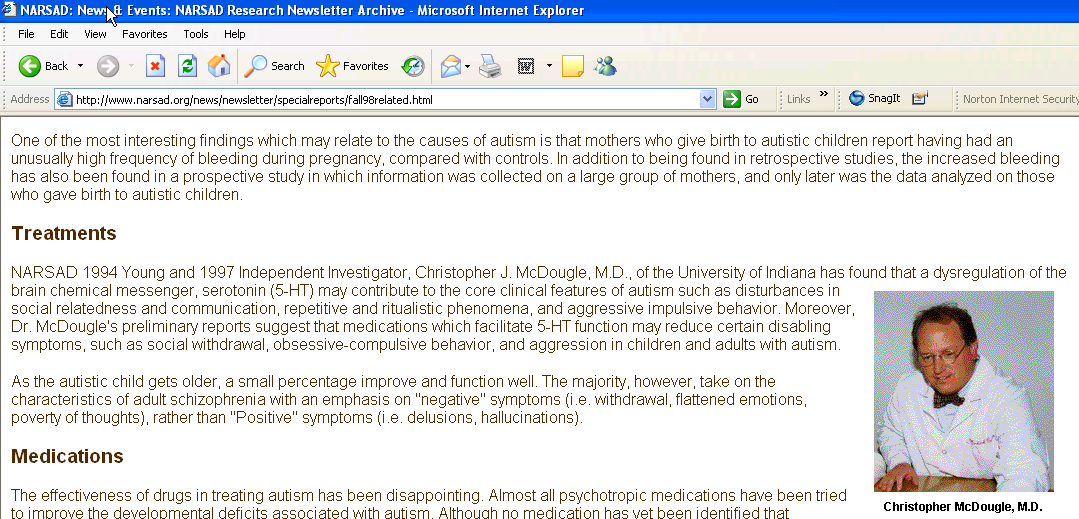
http://www.narsad.org/news/newsletter/specialreports/fall98related.html
Thus, again, the role of the APO-E genotype could certainly play a role in terms of the “symptoms” seen, but the fact remained, that according even to this article, “the majority take on the characteristics of adult schizophrenia”.
Let us remember the “mental illness classification system” and the two approaches that were used in classifying mental illness:
Symptomatic: Based on symptoms, it would appear that given the comparison I had provided between autism and schizophrenia in the autism-Alzheimer’s-schizophrenia comparison chart and indeed, based also on the history of these disorders, the argument for “one and the same” for autism and schizophrenia appeared to be much, much stronger than any argument for “distinct disorders”.
Clinical: Based on “prognosis” and the statement made in the above-mentioned NARSAD article, clearly, the prognosis for both appeared to be “the same” in the majority of cases.
Given that NARSAD was the largest not for profit institution for research into schizophrenia, I would expect that their staff writers had an idea as to matters relating to schizophrenia and “where” their subjects “came from” in terms of their medical history and whether or not they showed signs of autism earlier in life and clearly, the article itself stated that persons with autism, for the majority, went on to develop adult schizophrenia!
So, in their own article, the authors attempted to tell us that these disorders were not the same, but completely destroyed their own argument as they went on to explain that the prognosis for autism and schizophrenia was basically “the same” with the “majority” of those with autism going on to “develop characteristics of adult schizophrenia”. In other words, “they are not the same, but, really, in the end, they are”!
Thus, the very fact that a child with autism went on to assume the characteristics of adult schizophrenia meant that – by definition – there was both a family history of autism and “schizophrenia” in that same family – indeed – in that same child – and so, autism and schizophrenia did “co-exist” in the same family after all!
Truly, this argument alone provided the overwhelming defeat or “checkmate” in the debate as to whether or not these were the same or separate and distinct disorders!
To argue that these disorders were “different” – clearly – in my opinion was totally unfounded based on either the symptomatic or clinical approach to mental illness classification and the very closely intertwined history of these disorders.
In this text, I had used an article written by NARSAD, yet, there were hundreds I had seen – just like it – that provided only half-truths when it came to the matter of trying to make autism and schizophrenia appear as separate and distinct disorders. A few subtle “differences”, surely, should not have been enough to separate these disorders when it came to mental illness classification because, quite clearly, they had a great deal more in common that not and truly, it appeared that the issues were really in “matters of degree” of affliction and that could quite readily be explained by time at which the assault to the brain had occurred (more on this later).
The simple fact was, however, that based on the article provided by NARSAD above, children with autism did go on to develop schizophrenia. In my opinion, whether or not one received a “label” of autism of schizophrenia, was perhaps more dependent on one’s APO-E genotype, the fact that professionals themselves had trouble distinguishing the two – for good reason – and also, in all likelihood, depended on those areas of the brain most impacted as this could provide slight differences in symptoms. The fact did remain, however, that even experts agreed that these disorders did not necessarily include “all symptoms” for one person. This “presence or absence” of a symptom here and there – again, was not reason for separate classifications.
Indeed, the fact that symptoms varied among those afflicted was a “sign” in autism, schizophrenia and Alzheimer’s. And thus, to classify these disorders as separate based on one or two differences, was in my opinion, simply ridiculous because the facts clearly showed that there were many, many more parallels among these disorders than there were differences – and in my opinion, as will become evident in this text, many of these “differences” could potentially very much be explained in terms of differences in the development of the brain and body over time.
If anything, the fact that autism and schizophrenia (what I saw as different degrees of the same disorder) were not both occurring in the same family – in different siblings - just proved that these disorders were not "genetic" in origin and that family genetics only influenced "extent" or "susceptibility to" the disorder in terms of "how severe" the impact. In my opinion, the move to classify autism, Alzheimer’s and schizophrenia as separate and distinct disorders was nothing more than a situation where: "If you can't make the facts (no genetic link could be found) fit the story (that pharmaceuticals and government agencies involved in vaccination programs argued these were “genetic” disorders)... change the facts (by creating “distinct disorders")!
This link provided a history of Schizophrenia and Alzheimer's:
http://iowa-mhcrc.psychiatry.uiowa.edu/MH-CRCpages/How%20Was%20Schizophrenia%20Discovered.htm
Note the comment in this link at the end of paragraph 2 - I quote:
"Schizophrenia, or dementia praecox, was originally distinguished from dementia in the elderly (later named Alzheimer's disease) because it occurred in relatively young people rather than older people". [end of quote, emphasis added, How Was Schizophrenia Discovered, The University of Iowa Mental Health Clinical Research Center (MHCRC)]. http://iowa-mhcrc.psychiatry.uiowa.edu/MH-CRCpages/How%20Was%20Schizophrenia%20Discovered.htm
Here's that screen print:
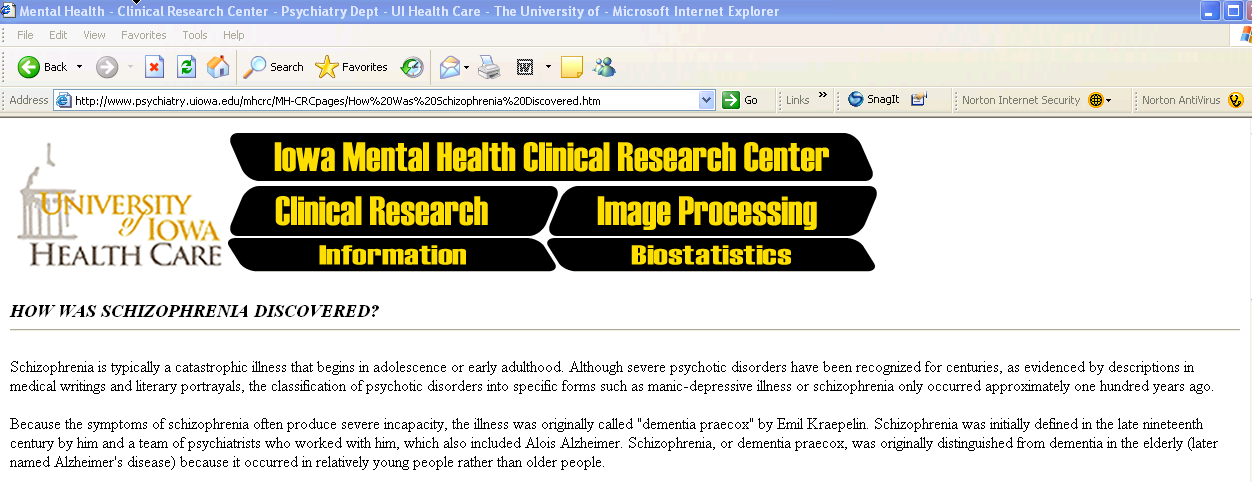
http://www.psychiatry.uiowa.edu/mhcrc/MH-CRCpages/How%20Was%20Schizophrenia%20Discovered.htm
Also noteworthy was the fact that the above organization, The University of Iowa Mental Health Clinic Research Center (MHCRC) stated on its website that its primary area of focus was – schizophrenia. As such, again, I would think that made them a “pretty good source” as to the “history” of this disorder. Thus, again, we see another indication of reclassification based primarily on “age of onset”. Again – for that to be valid criteria you needed a constant – the brain – and we now knew the brain to change tremendously over time! As such, “age of onset” could simply not be used as a criteria in the determination of whether or not these disorders were “one and the same”!
As I researched so many issues as they related to autism, schizophrenia and Alzheimer’s, what absolutely amazed me was the fact that many scientists appeared to see any brain abnormality found in "research" to automatically indicate a "genetic" reason for that abnormality while providing no data whatsoever to support what I saw as a huge leap of faith in coming to that conclusion. There were plenty of studies that stated, "yes, we found an abnormality in the brain" and the following sentence was basically... "so this was a genetic disorder" (often an assumption made it seemed based only on the fact that the abnormality occurred so early in life) and quite frankly, I just could not see how this huge leap of faith in terms of "cause" could be made with no data provided to substantiate the claim.
Could a "brain abnormality" not be caused by neural degeneration due to mercury or aluminum exposure or some other environmental factor?
Indeed, although twin studies had been conducted, the data so far was far from conclusive in showing a genetic link to autism. After all, twins shared more than simply genetics, they also share the same environmental factors - and that, in all likelihood, included having received immunizations at the same time, and quite likely, from the same "batch" or "lot". Also, the fact that a mother had twins usually meant slightly earlier than full term delivery and one child usually slightly stronger or heavier than the other – factors that could certainly impact one’s susceptibility to environmental assaults.
If indeed there was a genetic link to these three disorders, it certainly had yet to be found. Twin studies involving identical twins did not support a genetic link given that identical twins came from one hundred percent the same genetic code based on the fact that they came from the same cell and as such, if truly “genetic” disorders, then you would expect to always see both of the identical twins to impacted by these disorders – and yet, clearly, this was not the case. Often, one was impacted, and the other was not and that – in my opinion – meant there had to be something much greater than “genetics” at play. It would be that “something” I would attempt to find as I embarked on countless hours of research in an attempt to understand not only the similarities but also the differences we saw among these disorders.
As the missing link or any transitional life forms had yet to be found in support of the theory of evolution so, too, was there still very much a missing “genetic link” to autism, Alzheimer’s and schizophrenia. It truly appeared that, as in the case of evolution, theory was once again being taught – as fact!
And so, there I was – having investigated the history of autism, schizophrenia and Alzheimer’s and looked at our mental illness classification system – I, personally, could not help but come to the very painful conclusion that these disorders were but shades of the same thing – with differences most likely explained by “extent of assault” and stage of brain development at the time of the assault (i.e., aggressive vaccination schedules whereby toxic substances like mercury or viruses were injected into the body and lodged into the brain, etc.).
I knew there were many – even in the autism community – who would certainly want to deny that autism and schizophrenia were one and the same – as was Alzheimer’s. After all, for decades, we had been told that “they were different”, but, clearly, the facts - in terms of history, symptoms and prognosis - indicated otherwise!
For most in society, including myself, schizophrenia was a “great unknown” – a disorder associated with “crazy people”. Truly, the stigma associated with schizophrenia was a horrible one – and I suspected it was because of this that autism and schizophrenia were “said” to be different. After all, who wanted to tell parents impacted by the autism epidemic, or the children of those with Alzheimer’s, that what we were seeing was truly not an explosion in autism or Alzheimer’s – but one in schizophrenia! To tell a parent that his child had “autism”, for most, I suspected, was less devastating than to be told your child was schizophrenic!
Politically correct – or scientifically correct… fact or fiction…deception or truth… denial or acceptance – these were the choices so many families now faced in attempting to come to terms with these many issues.
As I attempted to come to terms with the truths I had so desperately sought and so painfully came to understand, the emotional devastation I felt – at times – was often overwhelming. That emotional rollercoaster I had known as autism had just intensified greatly in terms of its mass and velocity as so many issues now raced through my head and put me on a path I knew would involve many new unknowns, new turns, new spirals, new ups and, most frightening of all - new downs! My entire being, physically and emotionally – once again – as it had been when I had first realized Zachary had autism – felt completely twisted by a truth and pain almost too great to bear. The emotional rollercoaster I had known as autism, with basically no warning, had jumped onto a new, completely unexpected track that had the potential to rattle and shake me like never before.
Yet, for my son – again – I had to quickly come to terms with these issues and determine a plan of action. I could not wait for science or “the experts” for the answers I needed. Society’s view of schizophrenia was anything but kind. I knew science had been trying to understand schizophrenia for over one hundred years.
The easy response to all this would have been denial – simply convincing myself that this just could not be. My heart so wanted to believe that autism, schizophrenia and Alzheimer’s just could not be simply “shades of the same thing”. Yet, my instincts and my head told me otherwise.
I now realized that my “autism” family was much, much larger than I could have ever imagined. As such, I now provided – for free – all my books – in full - to all families impacted by autism, schizophrenia and/or Alzheimer’s on my website at http://www.autismhelpforyou.com.
My beautiful son… schizophrenia… my beautiful son…Lord, help me!
My brother’s favorite quote once again filled my thoughts:
“We cannot order men to see the truth or prohibit them from indulging in error.”
Max Planck, Philosophy of Physics, 1936
I had always sought the truth – and would do so again - as I now embarked on a much greater journey of the unknown. Autism had once been a great unknown also. Yet now, after countless hours of research and prayer, I seemed to understand it so much more. I would now set out to understand schizophrenia – and Alzheimer’s! Surely within the wealth of knowledge relating to these disorders, there had to be answers for my son – my beautiful Zachary.